
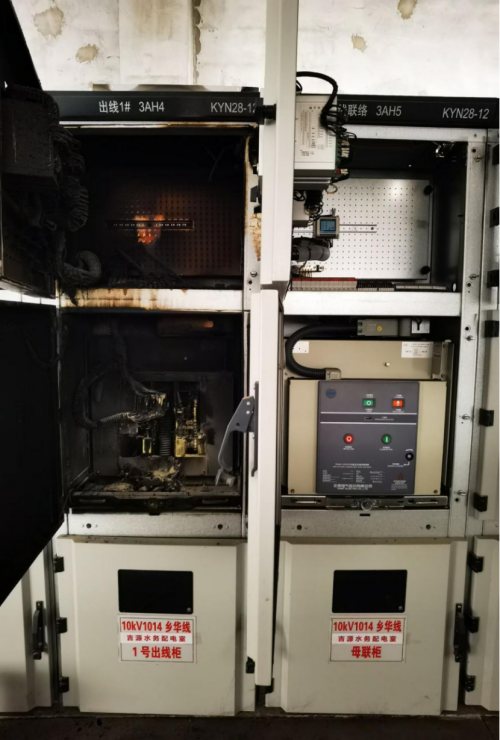
A reported switchgear incident involving a well-known Chinese manufacturer has drawn attention to the risks of internal arc faults in medium-voltage electrical equipment. The incident photograph shows severe burning inside a 10kV KYN28-12 switchgear panel, with visible damage to internal components and surrounding structures.
Although the exact cause cannot be established from the photograph alone, this type of damage highlights the importance of primary circuit connections, insulation integrity, vacuum circuit breaker (VCB) contact performance, and protection systems.
For switchgear manufacturers, panel builders, and maintenance teams, understanding the possible causes of internal arc faults is essential to improving equipment reliability and reducing the risk of similar incidents.
Poor cable termination, loose connections, damaged insulation, or inadequate contact between conductors can create localized overheating and electrical stress. If the insulation deteriorates sufficiently, an arc may develop between phases or between a phase and ground.
Cable terminations and connection points should be inspected for overheating, loose hardware, insulation damage, and signs of electrical tracking.
Primary circuit connections carry load current and must maintain sufficiently low contact resistance. Loose bolted joints, oxidation, contamination, or poor contact pressure can cause localized heating.
Continued overheating may accelerate insulation deterioration and contribute to a short circuit or internal arc. Proper assembly, connection checks, and condition-based maintenance are therefore important.
The primary contacts of a withdrawable vacuum circuit breaker must engage correctly with the switchgear's fixed contacts.
Potential problems include poor contact between tulip contacts and contact arms, incomplete insertion, contact misalignment, and insufficient contact pressure. These conditions may increase contact resistance and cause overheating at the connection interface.
Inspection should verify contact condition, engagement, alignment, and insertion position in accordance with the manufacturer's specifications.
Insulation failure can result from aging, moisture, dust, conductive contamination, surface tracking, or insufficient electrical clearance. Electrical overvoltage and partial discharge may also contribute to insulation deterioration.
Once the insulation can no longer withstand the electrical stress, flashover may occur between phases or from an energized conductor to ground, potentially initiating an internal arc.
Current transformers (CTs), bushings, and support insulators are essential to the electrical insulation system. Cracks, internal insulation deterioration, contamination, and moisture ingress can weaken their insulating performance.
Depending on the component and failure mechanism, the resulting discharge may develop into a phase-to-phase or phase-to-ground fault. Inspection and electrical testing should be selected according to the component design and the evidence found during investigation.
A vacuum circuit breaker includes a vacuum interrupter, operating mechanism, insulating components, and primary contacts. Abnormalities in these components may affect electrical insulation, contact engagement, or interruption performance.
If a VCB is suspected of being involved, investigators should examine the breaker position, contact condition, mechanical operating records, trip records, and relevant test results. The actual failure mechanism should be established before assigning the root cause.
Protection systems are designed to detect electrical faults and initiate circuit interruption. Incorrect relay settings, trip-circuit problems, delayed protection operation, or failure of the designated breaker to interrupt the fault current may allow an arc to persist longer.
The initiating fault and the factors that aggravate the damage must be distinguished. Protection performance may influence the duration and severity of an incident, but it does not necessarily explain what caused the initial arc.
An internal arc releases intense heat and energy inside a confined compartment. It can melt metal, damage insulation, generate hot gases, and create a rapid pressure increase.
The final extent of damage depends on several factors, including fault current, arc duration, compartment construction, pressure-relief arrangements, and the switchgear's internal arc protection design.
Fast fault clearing is important, but it does not eliminate all risks. Effective prevention requires attention to both the likelihood of a fault occurring and the ability of the equipment to limit its consequences.
Ensure reliable primary connections. Verify cable terminations, busbar joints, bolted connections, and primary contact engagement during assembly and maintenance.
Maintain insulation integrity. Keep compartments clean and dry, investigate signs of moisture or contamination, and replace damaged insulation components according to the manufacturer's requirements.
Inspect VCB contacts and mechanisms. Check tulip contacts, contact arms, insertion alignment, contact pressure where specified, and operating mechanism performance.
Verify protection performance. Review relay settings, trip circuits, protection coordination, and circuit breaker interruption performance. Consider suitable arc detection and mitigation measures based on the installation's risk assessment.
Conduct evidence-based fault investigations. Preserve relevant fault records and inspect damaged components when safe to do so. Determine the initiating failure and contributing factors before drawing conclusions about responsibility or equipment quality.
Internal arc faults in switchgear can have multiple possible causes, ranging from cable connection problems and primary contact deterioration to insulation failure and abnormal component operation.
The visible damage in this incident photograph illustrates why primary circuit reliability, insulation maintenance, VCB inspection, and effective protection are all important. However, the exact root cause can only be determined through a systematic investigation supported by physical evidence and electrical records.
For switchgear manufacturers and maintenance teams, the priority is to identify the actual failure mechanism, correct the underlying problem, and implement measures that reduce the risk of recurrence.
حقوق الطبع والنشر © 2025 Eberry Electric Group جميع الحقوق محفوظة
يستخدم هذا الموقع ملفات تعريف الارتباط لضمان حصولك على أفضل تجربة على موقعنا.

 English
 Español
 Portugues
 Pусский
 Türk dili
 Indonesia
 Tiếng Việt
 қазақ
 فارسی
 українська
 беларускі
 Filipino
 o'zbek
 български
 тоҷикӣ
 kiswahili
 Монгол
 አማራ
 Ilocano



 هاتف
تعليق
(0)